Do you ever feel the pain of being alone? Forgotten? Rejected? Misunderstood?
What do we do in the moments when those we expected to be there simply aren’t? When people who once promised unfailing love turn their backs in the very moments we need them most? When we speak with one intention, only to discover that something completely different was heard? When disappointment, misunderstanding, betrayal, and loneliness begin pressing against our hearts, something deeper than our circumstances is taking place.
The question is not whether we will experience pain. Every one of us will.
The question is what we will do with it.
Because what we do with our pain determines whether we slowly spiral toward death or begin walking into life.
One of the greatest strategies of the enemy is convincing us that our pain is the problem. In reality, the pain itself is rarely what destroys us. It is the interpretation of the pain.
The devil is incredibly strategic. Scripture says we wrestle against the wiles of the devil—his carefully crafted methods. He rarely begins with destruction. Instead, he plants subtle thoughts that feel true because they were attached to a real wound.
“They left because you’re not valuable.”
“No one will ever understand you.”
“God must have forgotten you.”
“Don’t trust anyone again.”
“Protect yourself. Isolate yourself. Shut your heart down.”
Those thoughts arrive like seeds. They often carry enough truth to appear believable, but their root is deception. If believed long enough, those lies begin producing an experience of death long before anything around us has actually changed.
The enemy knows that pain makes the soil of our hearts tender. His desire is to plant lies there before the Father plants truth.
We see this all throughout Scripture.
There were two gardens.
The first was Eden.
Pain entered the human story, and Adam hid. Shame drove him into isolation. Fear convinced him to cover himself. Rather than running toward the Father, he ran away from Him. The result was separation, hiding, and death.
Then there was another garden.
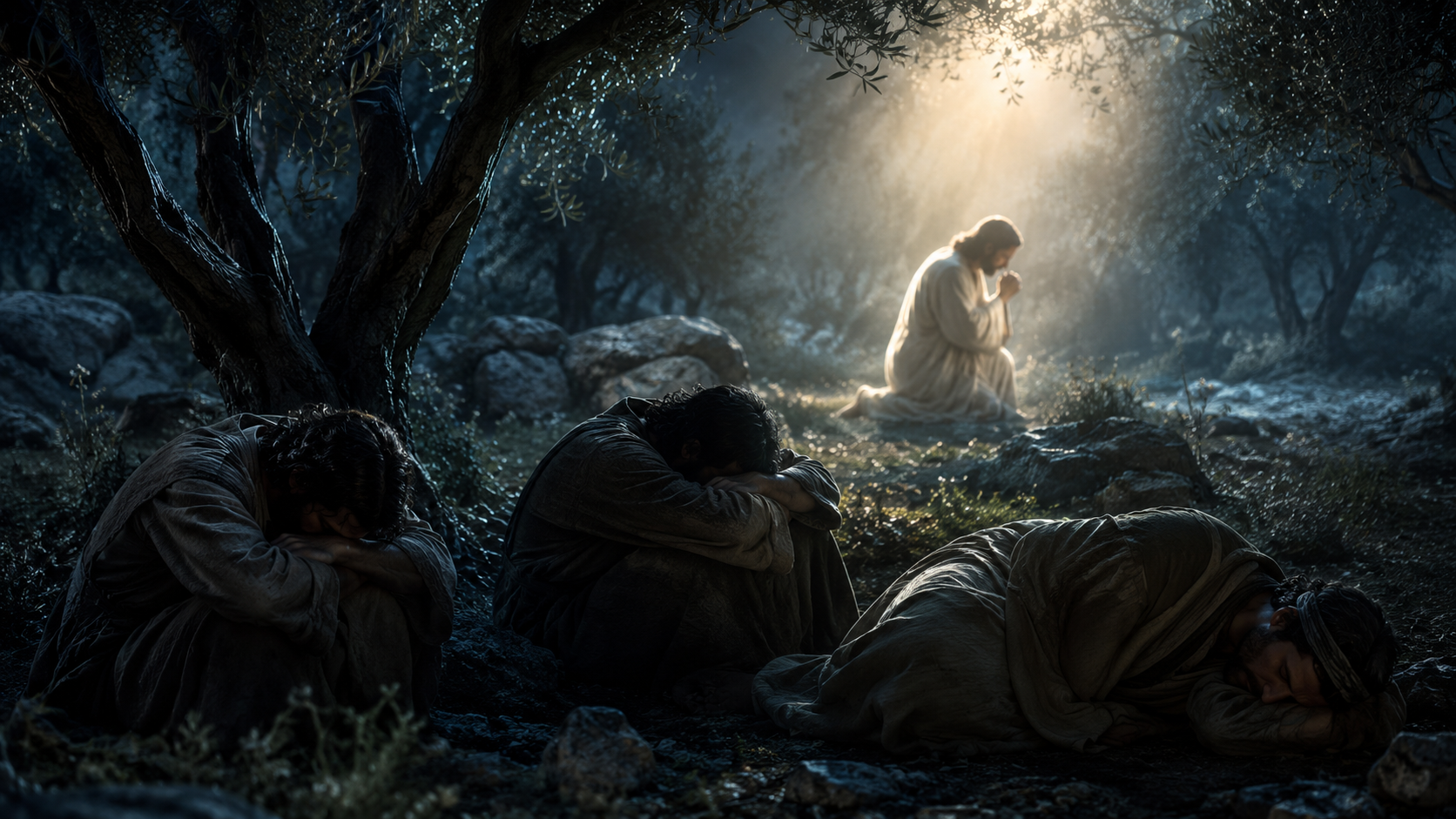
Gethsemane.
Once again sorrow entered the story. Jesus Himself said, “My soul is overwhelmed with sorrow to the point of death.” The disciples weren’t merely tired that evening. Luke tells us they were exhausted from sorrow. The weight of disappointment, confusion, and grief had become so overwhelming that they simply fell asleep.
How often do we do the same?
Maybe we don’t physically fall asleep, but we spiritually drift into it.
We distract ourselves with endless scrolling. We bury ourselves in work. We stay constantly busy. We binge entertainment. We numb ourselves through substances, accomplishments, productivity, or endless noise because silence would force us to acknowledge the ache within our souls.
Sorrow has a way of making sleep feel easier than presence.
Yet Jesus offered His disciples something entirely different.
He didn’t tell them to simply try harder.
He didn’t tell them to become emotionally stronger.
He didn’t tell them to figure everything out.
He gave them one invitation:
“Watch and pray.”
In other words, stay awake to My presence.
That invitation remains the same today.
The greatest danger in seasons of sorrow is not weakness.
It is spiritual sleep.
The enemy doesn’t always need believers to fall into obvious sin. Sometimes all he needs is for us to become distracted enough, discouraged enough, or exhausted enough that we slowly drift away from abiding in the presence of God.
Jesus knew something His disciples had not yet discovered.
Prayer is not merely where we ask God to remove our pain.
Prayer is where pain loses its authority to define reality.
Prayer is where heaven begins interpreting our circumstances instead of our circumstances interpreting heaven.
God’s first desire is not always to immediately remove what hurts us. More often, He desires to reveal Himself within what hurts us. His presence begins changing us before our circumstances change around us.
This is why Jesus could endure the cross.
It wasn’t because the cross became less painful.
It was because communion with His Father was greater than the suffering before Him.
Every season of sorrow presents us with the same invitation.
Will we hide like Adam?
Or will we pray like Jesus?
There is a reason Jesus said we are blessed when we are poor in spirit and when we mourn. He wasn’t glorifying pain. He was revealing that sorrow has the potential to become one of the greatest doorways into intimacy with the Father.
Brokenness has a way of removing our illusions of self-sufficiency. When everything else feels uncertain, we suddenly become aware of how desperately we need His presence. The very thing we spend so much of our lives trying to avoid often becomes the place where we discover Him most deeply.
I sense many people are living in exactly this kind of season.
Relationships have become strained.
Friends have disappeared.
People have misunderstood your heart.
Doors you expected to open have remained closed.
Some of you have quietly begun wondering if God has forgotten you.
Hear the Father’s voice.
He has not abandoned you.
The enemy wants you to interpret your loneliness as evidence of God’s absence.
The Father wants to transform your loneliness into an invitation to experience His affection in ways you’ve never known before.
The enemy wants your pain to convince you that you are unloved.
The Father wants your pain to become the place where His love becomes undeniable.
This is why Psalm 16 is so powerful.
David was not writing poetry from a pain-free life. He was describing what happens when someone continually sets the Lord before them. Circumstances may still be unstable. Relationships may remain unresolved. Questions may remain unanswered.
Yet something remarkable begins happening inside.
Joy quietly replaces despair.
Peace begins governing thoughts once ruled by anxiety.
Hope starts overcoming hopelessness.
Nothing around you may have changed.
Yet everything within you has.
“In Your presence is fullness of joy; at Your right hand are pleasures forevermore.”
The fullness of joy is not found in the absence of pain.
It is found in the presence of God.
Today, don’t waste your pain trying to escape it.
Don’t isolate.
Don’t numb yourself.
Don’t fall asleep spiritually.
Instead, allow your pain to become an altar. Let every disappointment become incense before the Lord. Let every tear become worship. Let every misunderstanding become another opportunity to hear the only voice that ultimately defines your identity.
The very place the enemy intended to become your grave can become the place where you encounter the Father’s affection more deeply than ever before.
If you will refuse to numb yourself and instead lean into His presence through prayer, I believe you will discover something the enemy never intended.
The sorrow that tempted you to isolate will become the doorway through which you experience the fullness of His joy.
Seek Him with all your heart.
Not because He is far away.
But because He is already nearer than you realize, waiting to reveal Himself in the very place where you have been most tempted to believe He was absent.

Carry The Fire provides tools for cultivating an inner life of knowing God intimately, while walking in the power of God courageously.

Hillsboro, KS